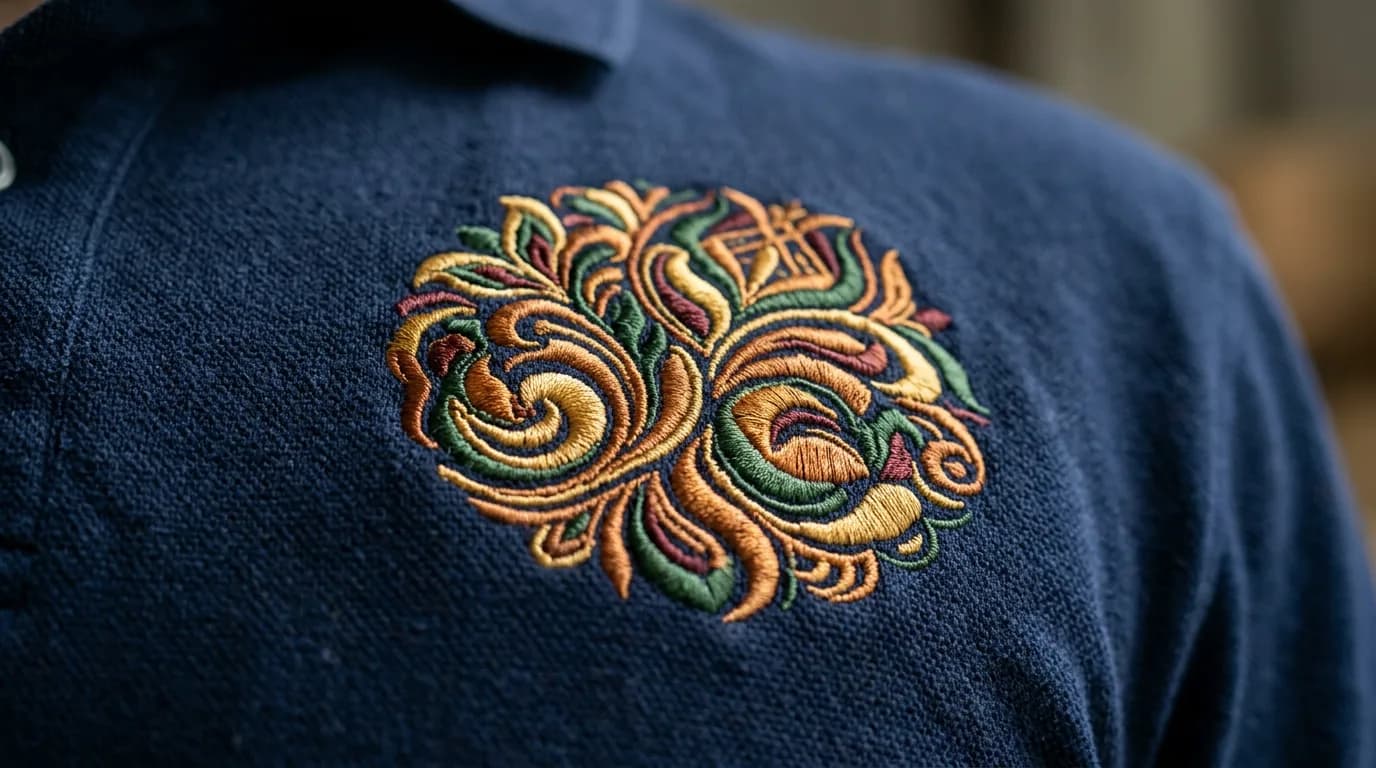
A logo that looks crisp on screen can come back from a sew-out looking blunt, closed up or oddly heavy. That is almost never a digitizing failure. It is the difference between a medium with effectively infinite resolution and one where the smallest mark you can make is a stitch roughly a millimeter wide, laid into fabric that moves.
The limits, as numbers
| Element | Practical minimum | What happens below it |
|---|---|---|
| Lettering cap height | 5 mm / 0.2 in | Counters fill in; an "e" becomes a blob |
| Line weight | 1 mm / 0.04 in | The line breaks up or disappears entirely |
| Gap between elements | 1 mm | Adjacent shapes merge into one |
| Isolated detail | 1.5 mm | Registration drift makes it land inconsistently |
These are not conservative numbers invented to make life easier. They are what survives on a garment that gets worn, washed and pulled over somebody’s head a hundred times.
Push and pull
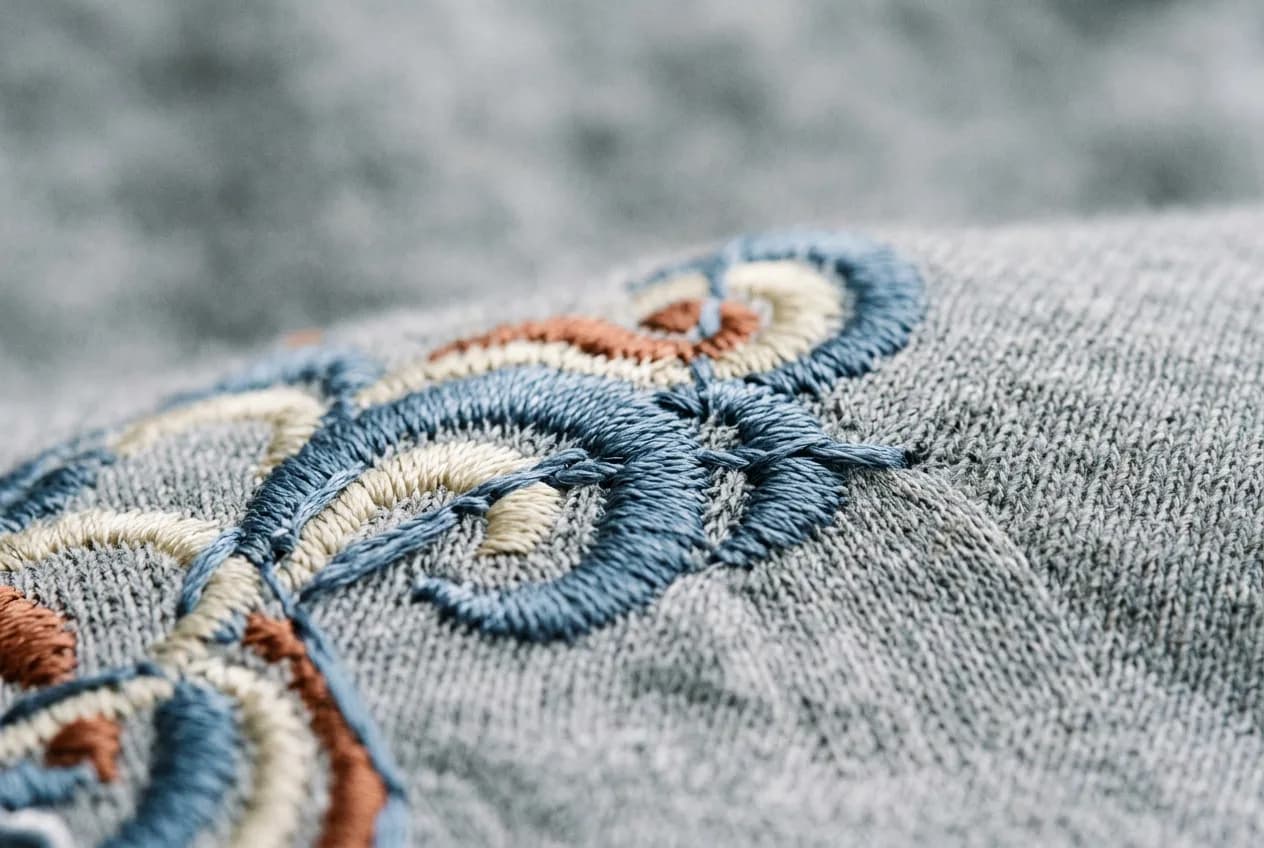
Stitches pull the fabric inward along their length and push it outward at the ends. A digitizer compensates by drawing shapes slightly wider than the artwork, which is why a circle that measures exactly right in the file sews as a very slightly wide oval unless somebody accounts for it. On a stable woven fabric the compensation is small. On a loose knit or a piqué polo it is significant, and it is fabric-specific — which is why the same file should not be run blind across three different garments.
What to change in the file
- Outline your type. A font we do not have substitutes silently, and nobody sees it until the sew-out.
- Expand strokes rather than leaving them live, so line weight is explicit rather than inferred.
- Simplify anything below the limits above rather than hoping. A mark redrawn for thread reads as intentional; the same mark shrunk reads as a mistake.
- Send the sewn size in inches or millimeters. A logo judged at business-card scale tells us nothing about how it runs at 3.5 inches wide.
- Say what fabric it is going on. It changes underlay, density and compensation.
The cheapest fix to any embroidery problem is a redraw before digitizing. The most expensive one is a reorder after production.
When to print instead
If the artwork genuinely needs fine detail, a gradient or photographic content, thread is the wrong medium and no amount of digitizing skill changes that. That is the case for DTF: it reproduces what you drew rather than interpreting it. Plenty of orders run a printed full back and an embroidered left chest for exactly this reason.